Archives for 2008
‘Some Day Your Cross Will Come’
Finding allegory or historical resonance with disconnected and often unrelated facts is now a commonplace. We are told to “Blink” and ‘thin slice’ our life experiences to ‘think without thinking’ (erudition and analysis are ‘overthinking’). We see it all around us; we all have noted it here dozens and dozens of times together. All perfect for Agit Prop in the Cowell-TMZ-Situation Room sludge posted earlier.
You know our view re comparing a speech from a two year Senator whose life experience really has been “community organizer” (whatever the hell that really means) with Abraham Lincoln in a deliberate Agit Prop effort to equate both men in historical presidential terms, and so on. One might be tempted to say that even now, within the bowels of Simon & Shuster a manuscript boils over, soon to unveil the truth beyond credulity that Donald Trump is our modern Prince Siddhartha Gautama (the real one). ‘Thin slicing’ after all allowed a cabal to railroad morons like the Warlord, General Jello and Cher Condi to “blink” and sign off on invading the Middle East to spill blood, national honor and treasure. (GJ actually caved as we all know but you get the gist).
Our lives and world are unfortunately not so tidy; ‘thin slice’ is also a pizza order.
‘Paralysis of analysis’ also is real. Certainly Rumstud post Baghdad capture highlights that. We are reminded of a quasi apocryphal story involving a Soviet defector. Suffering claustrophobia, he is taken to a shopping center to get out, get used to the non-GUM world, and of course further tempt cooperation by exposure to more insidious capitalist offerings. Our defector is meandering down the toothpaste aisle and suffers complete and total brain lock. Literal paralysis. Too many brands, too many claims, too many labels. If only we had known earlier the tangibly devastating power of Colgate, Crest and Listerine. (Levis don’t count, every Sov wanted *those* even before the Helsinki Accords).
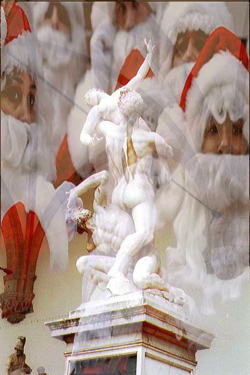
So what a disappointment to read the reviews of Die Soldaten (The Soldiers) which opened this last Saturday, July 5th (for 5 performances only). And how startling to see the most insightful coverage of such a major cultural and staggeringly expensive event in all places, the WaPo (most often a furniture or car dealer advertising circular adorned around the margins with text per earlier post). This opera’s staging in the Park Avenue Armory by all accounts already has exhausted the Lincoln Center Festival’s finances.
The monumental 4 act opera by Robert Zimmerman is usually regarded as one of the most important musical compositions of the second half of the 20th century. And in the same breath, as our friends at the New York Sun recognized in June 2008 along with millions of others, it is nearly impossible to perform. Based on a 1776 play by Jakob Michael Reinhold Lenz, the work presents many facets, the two most popular? A meditation on war’s destructiveness, or ‘Dangerous Liaisons’ without Michelle Pfeiffer or the recent revival.
Not everyone shares these concerns: the Grey Lady simply tosses out a bland summation by the AP in both NYT and IHT. Surely someone can play Frank Rich for a day. Separately, the Times writes a musical critique, closing with:
An unfortunate drawback of this ambitious production is that the seating area accommodates fewer than 1,000. With only five performances and top tickets going for $250, not everyone who wants to see it will be able to do so. But those who do will experience a miraculous realization of an opera once deemed unperformable.
Yet Anne Midgette in the WaPo catches something when she cuts through the NYT’s gushing waffle and simply states “[the] music sounds like the expression of a broken and angry century.” She adds tellingly, one reason for the work’s mystique is that on the extraordinarily rare occasions the huge finances can be found to stage it all, it overwhelms a select audience with sheer brute force. (The equivalent of a certain quartet with Marshall and Hi Watt amps overwhelming a stadium audience with 126 db 32 meters from speakers) (for which quartet in their prime, as long time readers know, the Stiftung has great affection). The use of a vast armory house a rolling audience, orchestra and staging? Not so impressive. The NY Sun, interestingly, quotes the musical director, Steven Sloane thusly a month before the debut:
Mr. Sloane expressed a similar attitude toward the music. “Everyone views it as a big bombastic piece, but it is actually the opposite; it is a very intimate, direct, emotional, musical language,” he said. “Once you get past the almost super-dimensional difficulty of actually playing the music,” he continued, “it actually becomes quite chamber-like.”
Channel hopping we heard Ozzie Osborne once complain without any trace of irony that none of his contemporaries understood melody and his musical subtleties.
David Pountney’s opera production’s grandstand is set on rails to move the audience allowing Zimmerman’s simultaneous past, present and future narratives to unfold. Ms. Midgette’s annoyance that it ultimately amounted to a confusing an distracting gimmick rings true. You know things are shaky when the *WaPo* says the singing was worthy “of a respectable regional production”. That Marie, whose downfall is the center of the piece, now is gang raped by a number of men dressed as Santa Claus (rather than soldiers in the original) sums up a lot. Catherine Mackinnon’s reaction would be beyond imagination were she able to (or want to) snag a ticket.
The photography montage at the WaPo article is worth noting. It reminds us of an unbelievably and unintentionally hilarious and atrocious Soviet fashion show we sat through during the reign of the Old Men. Something, dare we say it, ineffable?
The relationship to “thin slicing?” Totally random per our above snark? Not quite. And not quite what you might expect given the scale and cost of this seemingly over produced stunt. Pountney’s current production originated at the German festival Ruhr Triennale in 2006.
Pountney says he had some reservations about whether the piece itself ever really “works” in a traditional theater. But, referring to the Jahrhunderthalle [equivalent to the Park Avenue Armory], he says, “I found it instantly possible to understand how it could work in that particular hall. I think I suggested the way we were going to end up doing it within the first four minutes of standing in the room.”
“The way” was to have the audience move through the production. Pountney sat the audience on two motorized platforms flanking a long but very narrow stage, which he now describes as an “epic table.”
Perhaps Messrs. Pountney, Sloane et al. should have consulted with Stanley Kubrick in the hereafter. Just for a short chat with eye contact. Over thinking can indeed be a drawback — ‘Eyes Wide Shut’. The theatrical release and Blu-Ray version of ‘2001’, however . . .
Did you just blink?
Don’t You Want Somebody To Teach, Don’t You Need Somebody To Teach, You Better Find Somebody To Teach
Okay, it is simply more trend reporting from the Times — perhaps Bill Keller should simply step aside for Anna Wintour. Otoh, David Horowitz also would be out of work. So it’s a mixed thing for them — especially in this current economy. Does the Times really have any choice in the age of Politico? What else can the Times do? It lost the battle for commodity 24 hours news factoids. Trendism is newsprint’s last stand. The Times failed miserably with Raines’ “flood the zone”. And there is always the shadow of Blair and Judy Miller. Chatter over the LA Times’ fiery arc fills the cafeteria. And lest one forget, a mere 22% of the Washington Post Co.’s revenue comes from the newspaper/website these days.

But back to the campus thing. Is this trend a trend or even a surprise? Demographics are always shaped by their When. In the Time’s random sample (apparently talking to 50 professors equals a national trend if one can also quote an association) the lead example only turned 14 when the Soviet Union and Cold War disappeared. Kurt Kobain and shoe gazers were still hiding in Seattle holes. Her entire teenage and college Ur Kultur? The boom years of the 1990s, wealth and opportunity, and annoyance at the petty polarization of the Imperial City politics, yada yada yada.
And these are youngsters in any event. Keeping their head down and punching the ticket for tenure. Even if they did not grow up with “Do Your Own Thing, Man”, In-A-Godda-Da-Vida or K-Tel records, the Times gets a twofer — another trend piece ‘revisiting’ this sample (such a hoary media device) lies in the Times’ future. The so-called newly scrubbed faculty ‘moderates’ are larvae re faculty politics; their false consciousness soon will be torn asunder. After all, as Henry the K said and we have quoted many times, “Faculty politics are so lethal because the stakes are so low.” [Insert Monty Python Peoples’ Front of Judea, Judean Peoples’ Front joke here]. And like even the most tawdry beach, there is always another wave — the Warlord, netroots and Grand Theft Auto Generation’s is still to break.
We’ve worked with and observed faculty/scholars at the most exalted of our institutions. A favorite story involves two extremely senior, perhaps brilliant scholars and media personalities. These are the kind of people who don’t really worry about getting on the Lehrer News Hour or placing an Op Ed in the Times or Post (or a very serious hearing from them). If they have something trenchant to say, they get a platform (Charlie Rose doesn’t count). Yet these two, at the time camping out at a famous institution and by every objective measure politically coeval, were locked in a deadly scorpion’s duel. Savage. The venom and tenacity of this struggle transcended ‘obvious’ consensus physics. The battle boiled over and created institutional fissures. The core reason? Who had more dibs on their shared secretary’s time and output. And that didn’t even involve battling for grant money. We do not joke.
Jaundiced? Perhaps. Nonetheless, we’re a bit leery — if not downright contemptuous — of trend reporting as peddled by the Times et al. Even more so when promoted by alleged independent columnists discovering ‘Bobos’. If the Times needs trend ‘reporting’ to survive, better perhaps to throw in the towel. Just find within its corporate conglomerate the equivalent of textual blatantly vacant eye candy. Emphatic prose from their version of Wintour and her cohorts. The NY Post with more textual Ralph Lauren.
We obviously need hard news desperately. As a society, we are sinking in a sludge of Simon Cowell, TMZ and the Situation Room. Pulp news’ long lamented demise is truly on our doorstep even now. No obvious solution appears to solve the Internet and cable disintermediation. Or the debilitating impact of corporate ‘news’ subordinate to P/L and conglomerate voraciousness. It’s true still that the Times sets the lead for other (failing) papers. Perhaps the step above might be its final and best service to its flock.
All the vacuity that’s fit to wink. Perhaps another reason Fox might outlast them. Its embrace of the ephemeral. That, and Photoshop.
Buying Time For History
Is the U.S. sliding into war with Iran? Sy Hersh may be right.
What most Oppositionists and certainly the ‘Left’ [sic] in the U.S. fail to understand is that the EU behind the scenes is on board. Rumblings from Brussels (not just Carla Bruni’s beau) are clearly hawkish. In fact, EU blatantly public worries are that the Crowned One ironically may undercut the UN like the Warlord – here, seeking to use personal charm for engagement while ignoring UN sanctions and other action.
Zbig’s weighing in on all this is getting stale. He needs to retire. His son is a lobbyist and law partner. His daughter is now a blondika version of J Fred Muggs to Scarborough. More importantly, Zbig’s argument that the Iranians sought the bomb *because* of the Warlord is simply specious. (Zbig is often an ass when he writes about things outside the Polish-Great Russian geopolitical corridor — his immature writings on Japan back on the day merely one example). The Iranian program according to most honest observers began to take shape during their war with Iraq.
Interestingly, while this unfolds, a leading Neocon, Jim Hoagland in the WaPo advocates a backhand strategy for Russia. He argues that the Russians are feeling American weakness and are pushing for the rollback of American power across the board. Hoagland is at least sober about in old Sov speak the relative ‘correlation of forces’ and how depleted American assets are under Cher Condi and the Warlord. Instead of the typical cant one expects from Neocons (and Hoagland) of standing firm, promoting democracy, freedom, Georgia in NATO, etc. Hoagland says something different. He offers that we should let the Russians push, until they exhaust themselves. Then he envisions a new equillibrium of punched out American and Russian visions — sobered and weakened. Very much like Manstein at Kharkov in 1943 (hence the back hand label) — although as we all know, ‘that whole thing didn’t end so good’ as the kidz say.
Is Tehran vaut bien un Conférence sur la sécurité en Europe on Russian terms? Would it even buy Tehran? We think not. Yet, oddly, this notion of talking as a strategy — or even accomodating to a rollback — is not too far from what is emerging from the Crowned One’s camp as the framing architecture of his world view and policy.
One must ask therefore if the Crowned One and his retinue understand Power. Sentiments are fine. Lofty rhetoric is a nimbus and neither here nor there. He holds a bad hand thanks to the Warlord et al. But the world is still anarchical and Power still determines how international law, international institutions and international discourse function. How will he achieve U.S. goals balancing the UN, Brussels, Moscow and Beijing with Tehran? If Zbig and the crowd we know tossing themselves at at future Administration are any clue, we truly fear a calamitous Kennedy – Khruschev summit in Vienna. With all the potentially catastrophic misjudgments that ensued. And that is merely one small example of the larger question: what is Obama’s principle about the purpose and role of American power in the world?
That question of course cuts both ways. Domestically, forget for a moment whether he wears a flag pin, ‘she rocks’ or if he says love of America (Amerikuh?) is a given. He has yet to explain and demonstrate to the American voter his vision in practical terms. Similarly, abroad, it is not enough simply to say he will reverse the Warlord’s policies. Across the globe, everyone is asking the same question: does the Crowned One understand how to use and impose Power? Many of those flocking to the banner of Change for appointments do not, in our opinion. Talk as a strategy for buying temporal space can make sense — engagement — if part of a coherent framework that is strategic and furthers both American interests and power (not necessarily identical). Even provocations domestic and foreign (read recent choreographed exercises) can actually be used as tools to make engagement appealing. Nimble opportunism can be a plus if the goal does not get lost. But in the end, it is all about understanding the application of Power. We do not mean the Warlord’s ultimately nihilistic (behind the facade) machtpolitik. The Crowned One’s position is unenviable. So much frittered away thoughtlessly the last 8 years.
We just wonder.
You Know, It Is Rather Odd Even After 2001-2008. . .
Oh, those crazy journalists. You know the ones I’m talking about. The one who described John Kerry as “French-looking” and made up some silly locution to show how out of touch he was — “Who among us doesn’t like NASCAR?” — even though he never said it. Or the one who taunted Al Gore for claiming that he and his wife, Tipper, were the models for “Love Story” when Gore said no such thing. Or the one who described Bill Clinton as an “overweight band boy” and Hillary Rodham Clinton as “inauthentic.” Or the one who tabbed Barack Obama “Obambi” and said that when visiting him at his office, she felt like Ingrid Bergman in “The Bells of St. Mary’s,” having to teach a bullied schoolboy how to box. Or the one who kept pressing Obama at a debate to fess up to his relationship with a 1960s terrorist.
Of course, what do you expect from right-wing nuts who will do and say anything to demonize Democrats? Except for one thing. All these examples — and there are hundreds more — were uttered not by Rush Limbaugh, Ann Coulter, Bill O’Reilly, Glenn Beck, Sean Hannity, David Brooks or any of the other Republican mouthpieces in our newspapers and on our airwaves. They were all said or written by liberal journalists, and even in a few cases by onetime Democratic operatives turned journalists, such as Chris Matthews and George Stephanopoulos. Indeed, the worst offender by far, the “Ingrid Bergman” in the example above, has been the New York Times’ liberal columnist Maureen Dowd, who has never met a Democrat she hasn’t disparaged. . . .
As Rick Perlstein describes it in his book “Nixonland,” Joseph Kraft, an old, unregenerate liberal close to the Kennedys, was among the first to wonder aloud if Nixon wasn’t right. Maybe the news media had wandered too far from heartland American traditions and values of which Nixon presented himself as exemplar. Maybe journalists had become too insular, snooty and condescending. These kinds of ruminations tended to push the left-wing media toward the center as their way of proving that they were honest, objective and not beholden to anyone.
- « Previous Page
- 1
- …
- 10
- 11
- 12
- 13
- 14
- …
- 25
- Next Page »