So What’s ‘Decent Interval’ In Pashto? (سم لاسي پريږدو وقفي)

Very little actually happened during Obama’s stunt visit to Kabul. His mastery of obfuscating optics remains unmatched: America is leaving in 2014 to rebuild at home, except we are staying to ‘finish the mission’. The most cheeky line? His declaration that ‘the mission is on a clear path to success.’ Do tell.

Pure focus group gold. The twinkle in Obama’s eye during his speech seems to say ‘This is how you do it.’ Soaring verbiage for all persuasions and voila – Afghanistan politically neutralized for 2012. After that, not really his personal problem. Who says he can only slow roll news?

We’d prefer a more honest and coherent withdrawal. And an open rejection of nation-building, COIN and (add your list here). Afghanistan as an even moderately functioning society should be far more pressing for Moscow, Beijing, Islamabad and whoever is the next Mayor of Kabul/Afghan president.
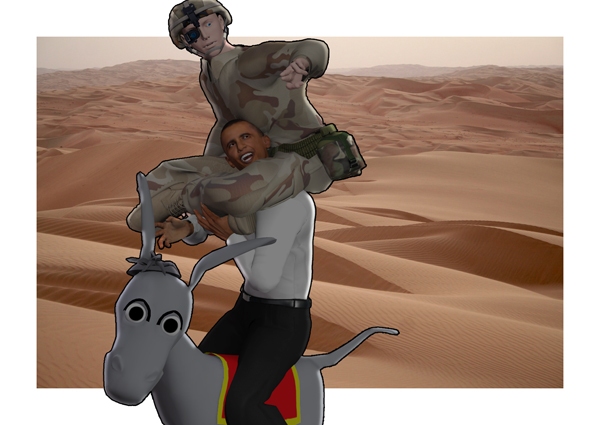
Afghanistan, Obama's Kabul Visit, Endless War, Lives And A Trillion Wasted

The scale of American profligacy over 13 years understandably makes a clean walk away difficult. Lives and a trillion dollars thrown away, mostly for nothing. A pointless surge that cynically bought time but accomplished little. An entire generation of national security bureaucracies and personal careers built on the whole Islamo-Terrorist/Drink-Tea-Complex. That’s a lot of inertia for Obama to take on. Particularly for one instinctively prone to compromise. So Decent Interval today is a more drawn out affair.

The $4-5 billion being brandied about as a post-2014 annual ante for graft aid to Kabul is expensive, even compared to Tel-Aviv. Sure, it keeps the American hand in the Great Game. In for a trillion, in for a billion, amirite? A lighter CT footprint requires some infrastructure and logistics after all. Obama concedes we’ll be in Afghanistan for another decade anyway.

Most of the aid money will be a psychological sop to alleviate American guilt. Does anyone really expect a dollar given to Kabul after 2014 to yield sudden benefit and efficiencies? Guilt’s emotional echo likely will fuel AgitProp for future mission creep again, most prominently from the so-called ‘Left’ [sic] with their emotional, impulsive ‘Responsibility to Protect’ (R2P) cant. The humanitarian calls for action here will be to alleviate oppression of helpless [gender/minority/pet] left destitute by callous abandonment. People may even Tweet about it. (We suspect those agitators (and Afghans) will be disappointed; America, once she’s psychologically withdrawn, will treat Afghanistan like an office party in a cell phone commercial ‘-so 45 seconds ago’).

Obama’s dazzling skill fuzzing up political conversation may be welcome in some quarters now. We’ll all rue it later. ‘Lessons of Afghanistan 2001-2014′ inescapably will be on a future political blackboard. Not that we as a society are particularly adroit at drawing lessons, let alone studying them.
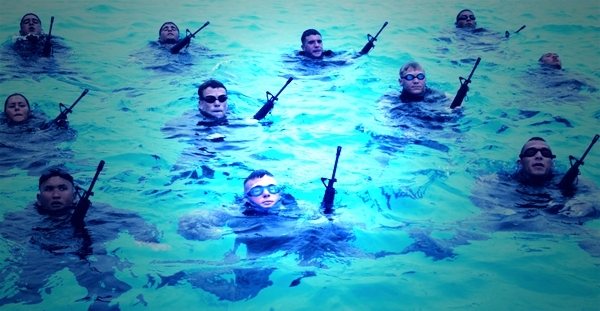

OK, Cameras Rolling People, And . . . ACTION!

The American military colossus arrives in a fleet of helicopters which British lack. When US Marines air assaulted into a notorious Taliban stronghold in the south of Helmand Province – far south of positions the British have struggled to hold for three years – they arrived in a fleet of Chinook and Black Hawk helicopters . . .

The US military colossus has moved into Afghanistan’s most dangerous and turbulent province, moving troops, aircraft and armoured vehicles in numbers which British commanders could only dream of through their years of frustrating battle against a determined and deadly enemy . . .

The well-supplied Americans are in stark contrast to their British brothers-in-arms, whose shortages of armoured vehicles and helicopters are the subject of political arguments at home. . .

Then on July 2, the US Marines arrived – launching their biggest helicopter-borne assault since the Vietnam War . . . After replacing British troops in central Helmand districts such as Garmsir, the American Marine commanders were careful to praise their predecessors – and the sentiment is genuine.

Commanders say they did a “great job” or they were “fantastic”. But the praise is qualified by an acknowledgement they didn’t have enough resources. “The Brits did a phenomenal job,” said one senior officer. “They didn’t have a lot of people, they were a force of maybe three or four thousand I think, and we are coming in with 10,000 Marines, so we got a lot more to do a lot more things. We just have a lot more people.”

If only it were true. It’s all nostalgic in a way. How re-assuring to have Brits marveling once again at ‘Over here, over paid and over sexed’. Very Churchillian in a pico sense. The Austrian Corporal History Channel knows how to program this narrative. Plucky Anglo-Americans riding together a wave of (relative) American tactical material abundance in one far off province to . . . victory.

Except we all know, like Col. Kilgore, ‘Hamid don’t surf, Sir!’ This elaborate military theater and psychological manipulation is aimed at both the local populace and the Mayor of Kabul’s emissaries. Most of the Taliban, especially their most valuable foreign operatives, have already withdrawn or melted away. Intentionally for both sides. We remain skeptical that once all the theatrical sturm und drang fades the ‘central government’ [sic] can exert consensual civilian control over the region to engender meaningful loyalty.

More than at any time since 2001, American and NATO soldiers will focus less on killing Taliban insurgents than on sparing Afghan civilians and building an Afghan state.

“The population is not the enemy,” Brig. Gen. Larry Nicholson, the commander of the Marines in southern Afghanistan, told a group of troops this week. “The population is the prize — they are why we are going in.”

To realize their goals, the Americans and their allies want to capture the area with a minimum amount of violence. American commanders say the attack on Marja is intended to be nothing like the similar size assault on the city of Falluja, Iraq, in November 2004. In that case, Falluja, under the control of hundreds of insurgents, was largely destroyed. The Americans killed plenty of guerrillas, but they did not make any friends.

“We don’t want Falluja,” General McChrystal said in an interview this week. “Falluja is not the model.”

At least there’s that.