A Military Perceived As Possibly Losing Grip

You’ve probably noticed numerous military (or special operators) personnel acting out against Democrats and President Obama. Some are active duty, some are retired. All are leveraging their public-funded training and experience for partisan advantage.

Military Headaches Come In Threes?

The three most recent incidents are: (i) a group of low-ranking active duty military committing murder to further a scheme to assassinate the president; (ii) a former SEAL trying to publish a book on the UBL raid without submitting it for clearance; and (iii) that now well-known front group of former SEAL and special operators attacking Obama for the election. (Video h/t @Sam_Lowry_USA).

No one should deny anyone’s First Amendment rights if retired and in compliance with classification rules. Still, these examples risk creating the perception of the military as just another partisan special interest group. And it’s perceptions that are important here.

Senior military leadership have an opportunity to set or re-establish bright, emphatic lines of expected behavior. And communicate what’s permissible, even if unwelcome. In a healthy domestic political environment, much of that would be undertaken by both parties. What is crucial is that communication occurs.

We’re just entering the first phase of resource contraction for the military/intelligence/contractor community after unprecedented largesse. Severe domestic cuts are also likely, regardless of November’s results. The service chiefs need to look ahead.

The Military Benefits From Clarifying Bright Lines

Chairman JCS Dempsey’s statements that he’s “disappointed” by recent events and that they “don’t make my job any easier” are candid but only a tepid first step. Admiral McRaven’s reaction to the SEAL book, while adhering to an unwritten code of understatement, should be only the beginning in clarifying for the public what is or isn’t permissible activity. Especially after a year of ‘leaks’ being used as a partisan wedge issue.

Public trust is a crown jewel for the military but can be fragile. Internal military cultural signals, personnel shifts, etc. to address recent events won’t be enough. This isn’t about trying to clean house at Colorado Springs because of Evangelical excesses. A national stage is involved. Given the permeability of military culture with the civilian social networks, service chiefs can’t assume their cultural signals are axiomatically ascendant.

Conclusion

These three events occur amidst the long-standing civilian-military divide. We’ve devoted decades to following that matter and tried to focus attention in the 1990s. We spoke about it with the old Office of Force Transformation, NDU and elsewhere. Lots of smart people work the problem; solutions still elusive.

We’d be the first to argue that civilian inattention and indifference to obligations, commitments and cultures remains a large contributor to the gap. We see little sign of civilian leadership and culture changing focus soon. Work must be incremental in both directions. Yet the military is subordinate to our civilian society and must remain so.

All the more reason for the military to do its utmost to assure the public it remains apolitical. To be be perceived as such. Above all, we urge that when in doubt, err on the side of communicating where its control over personnel and their actions begins and ends.

Share and Enjoy

  • Facebook
  • Twitter
  • Delicious
  • LinkedIn
  • StumbleUpon
  • Add to favorites
  • Email
  • RSS

What Exactly Does Civilian Control Over The Military Mean In A Demotic Age?

Movement intolerance for any individual or institution that breaks their role as obedient prop can be famously vindictive. Even a prop as sanctified and invested with hollow tropes as the U.S. military.

Witness Paul Ryan’s recent outburst against the services. Ryan bemoans that the military isn’t revolting against budget rollbacks from current record levels. Ryan denounces Pentagon budget proposals, saying:

“We don’t think the generals are giving us their true advice,” Ryan said during a forum on the budget sponsored by the National Journal. “We don’t think the generals believe their budget is really the right budget.” [...] He went on to say that while there were certainly inefficiencies that could be reduced in the Pentagon’s budget, fighting wars in the Middle East and a “dangerous world” necessitated keeping defense spending level.

Ryan added that “What I believe is this budget does hollow out defense. I believe this budget goes beyond where we should go to keep people safe.”

In the inside baseball world of D.C. power, it’s easy to dismiss Ryan’s judgment. He doesn’t sit on a defense authorization/appropriations committee and has almost no granular expertise on defense postures, industrial base or commitments. But as Chairman of the Budget Committee, Ryan lurks at the aorta of Movement radicalism in the House and nationally. This distinguishes him from say, John Kasich, who tilted at windmills called the B-2 back in the day. Ryan’s stoking of Rightist rage against the domestic social contract while adding yet still more to the defense budget moves the political needle and thereby redefines the middle for the Goldilocks mindset. In the long run, control of political narrative wins, trumping objectively factual expertise almost every time. That’s the New Normal.

U.S. Military, Budget Crisis, Paul Ryan

Ryan’s political frustration is palpable: after a decade of trebled budgets, car window dohickeys and treacly Super Bowl rituals, the military now is going rogue? Ignoring the script of Obama’s menace to national security?

Chairman of the Joint Chiefs General Dempsey doesn’t like being called a liar. And in a Twitterverse of 140 characters it would end here. Personality clash, with initial smack talk all shut down by Dempsey’s atomic knee drop. Booyah.

Except larger questions about civil-military relations remain. We speak not of Ryan’s clumsy attempt to suborn military insurrection. The U.S. military over the centuries has seen and rejected that gambit before.

Similarly, the military’s institutional memory remembers draw downs in the past – whether post 1945 (WWII), post 1953 (Korea), post 1975 (Nam) or post 1991 (Sovs). This is not their first rodeo. Bartering political trade offs and stunt posturing they leave to Leon Panetta, who is laboring mightily to earn his seat in the Building. The services know that across history, adopting a long term view in the face of budget rollbacks allowed them to emerge ultimately more capable later. It’s one reason the military internally is more realistic about the dangers of American fiscal (and social) implosion than professional politicians. Still, they’ll game the system in the here and now, too. They’re not idiots.

What makes 2012 qualitatively different is the pervasive abstraction of demotic America and her government. Never before has a military of this scale and capacity been subordinate to such an impulsive, consequence-free, meme-drenched polity. After all, ‘serious’ people actively pursued two new wars (Syria and Iran) and came damn close to getting at least one. Obama, just a year ago, unilaterally waged war against Libya on his own initiative, against military advice and without congressional penalty. That’s a precedent with unknown consequence.

Certainly earlier eras endured bitter partisan ideological differences, especially after 1975. Political institutions, however, retained their identity, sense of (constitutional) purpose and political coherence. Whether one agreed with Barry Goldwater on Taiwan or the Boland Amendment, separation of powers and checks and balances meant something. Today? Not so much.

People accept today that political institutions are almost notional and pro forma – mere backdrops for the ever malleable political narrative of The Moment. The U.S. military so far remains apart from the general meme-soaked dissolution. That’s not to say Tweets and burps aren’t present. But as the Marines demonstrated recently, discipline extends to Facebook, too. We think it a good decision. The services’ internal culture and discipline still makes them the most successful enrolling institutions beside the Catholic Church. They’re not immune to fads and internal meme stupors, of course – witness Colorado Springs, RDO, EBO, Warden, NetCentric Warfare, Wehrmacht-esque infatuation with operational success, etc. COIN, anyone?

It’s always a mistake to project linear change into the future. Still, one can’t help but dread the day civilian control over the military simply means ‘Likes’.

Share and Enjoy

  • Facebook
  • Twitter
  • Delicious
  • LinkedIn
  • StumbleUpon
  • Add to favorites
  • Email
  • RSS

“One possible future. From your point of view… I don’t know tech stuff.”

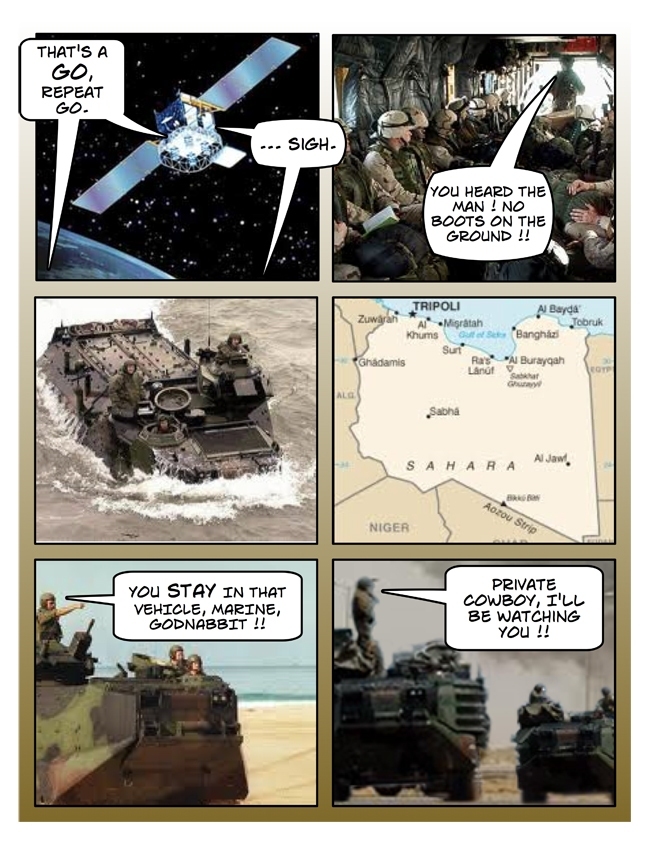
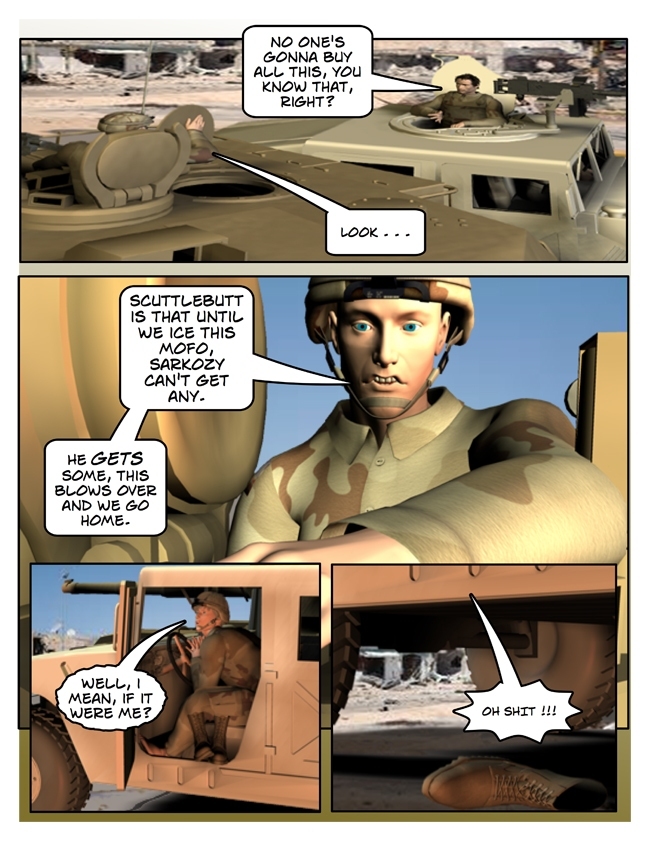
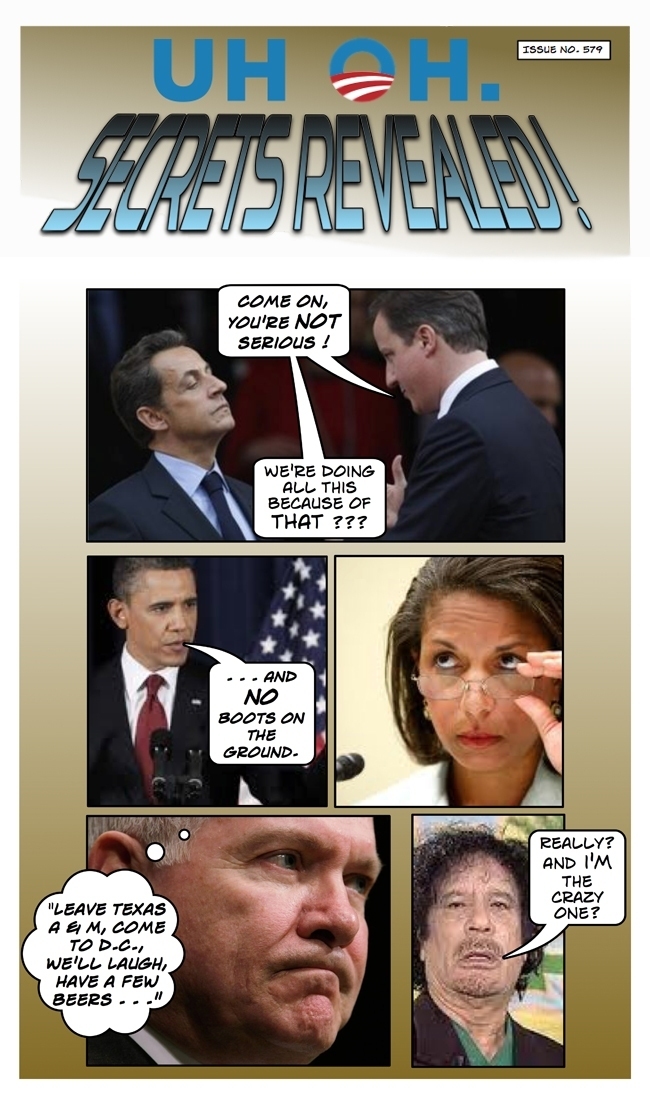
Welcome to another Stiftung Comic, this ‘ish, “NATO STRIKES!”

The Secret Behind Sarkozy’s Mania To Attack Libya

The comic issue begins with the fateful decision to bomb Libya. . .

____________________

Obama declares his firm decision that he will bomb and attack Libya, but no boots will ever touch Libyan soil. The U.S. military follows its orders to the letter . . .

____________________

But even the best military plans go awry . . .

Share and Enjoy

  • Facebook
  • Twitter
  • Delicious
  • LinkedIn
  • StumbleUpon
  • Add to favorites
  • Email
  • RSS

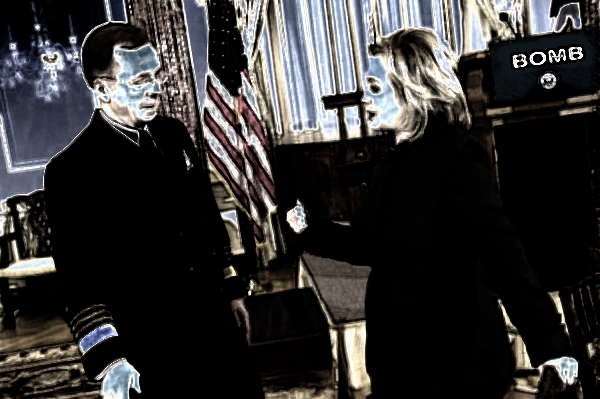
Listening To Admiral Mullen Tonight It’s Worse Than Thought

Admiral Mullen is a supple intellect and adroit interpersonal politician in marked contrast to his two hapless, unlamented predecessors. He effortlessly maintains zero daylight between him and the Commander in Chief while still sending oblique messaging. We saw more nuance in him being up close than guessed before reluctantly accepting tonight’s invitation.

The Whisper Of Spread Spectrum

As Mullen recited the Administration line several points seeped through in interstitial spread spectrum whisper. First, it’s clear (to the Stiftung, at least) Mullen remains unenthused about the State/White House slap-dash ‘winging it’ decision-making. He is aligned with his boss, although Gates did the patented Washington-two-step earlier on the Hill, assuring that ‘all alternatives were *exhaustively* examined’. (Clever phrasing).

[Read more...]

Share and Enjoy

  • Facebook
  • Twitter
  • Delicious
  • LinkedIn
  • StumbleUpon
  • Add to favorites
  • Email
  • RSS

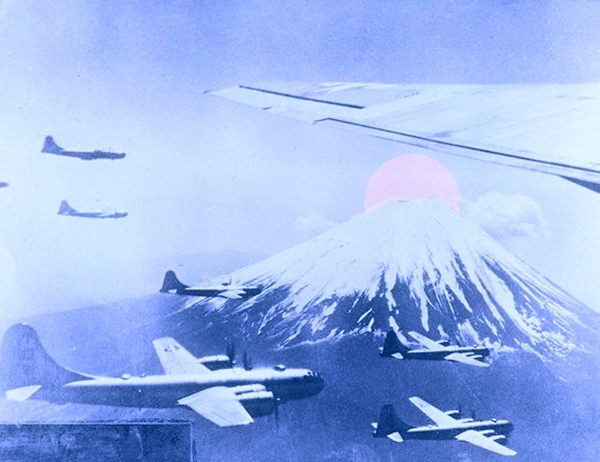
American Air Power This Day In History

March 9, 1945 marked the beginning of the new American incendiary bombing of civilian targets in Japan. Low-flying U.S. warplanes carrying 65% more bombs over the next 2 says created the largest firestorm in recorded history, killing 80-130,000 civilians and destroying 16 square miles. Curtis Le May told the bombing crews they would be “delivering the biggest firecracker the Japanese have ever seen.” By July 1945 such low-level incendiary raids proved so devastating that LeMay declared no worthwhile targets existed in Japan.

These raids killed more people and caused greater damage than the subsequent atomic bombings. The stench from the burning bodies sucked into the firestorm and the blood, turned into mist and wafting on the wind, was so intense Americans in the B-29s turned on their oxygen masks to keep from vomiting.

The raids, however, failed to achieve their goal. As with the British and American air attacks on Germany earlier, the Japanese overcame their initial shock and their morale bounced back. Only the threat of existential atomic obliteration changed matters.

_______________________________

Useful to keep in mind listening to air power advocates today. Air power lost some prestige after last decade’s Air Force failed fantasies of compelling war terminating outcomes with Rapid Decisive Operations. Just a few years before the Balkans demonstrated the same truths. Air power failed to achieve a meaningful result. NATO turned to a threatened ground assault to bring that operation to close. The 1991 Gulf War? Same.

America seemingly chooses to forget. Airpower tempts with an illusory clean solution, fixed without need to get dirty on the ground. La plus ca change.

Share and Enjoy

  • Facebook
  • Twitter
  • Delicious
  • LinkedIn
  • StumbleUpon
  • Add to favorites
  • Email
  • RSS

Military Chic Contagion

Traditionally, commanders hand out the [Challenge] coins to troops for exemplary service and morale boosting. That’s how Duckworth got hers. That’s why it meant so much.

But in recent years, many outside the military have adopted the tradition, turning a sacrosanct ritual, some say, into a form of military chic that is now part of the Washington power game. The coin craze extends into almost every nook of the federal government. The secretaries of education, transportation and agriculture have coins. So does the EPA administrator, and even the Department of Agriculture’s Office of Information Technology.

The coins have gone global – the Australian ambassador has one. And corporate: Boeing has a coin. So does Starbucks.

Just another symptom of America’s aping military culture for hollow status and plain jock sniffing. It’s part of a pervasive tapestry of military jargon and even practices seeping into our domestic lives. What’s remarkable about the HBGary story is how little coverage it generated in the traditional media. Defense contractors gleefully and mostly without internal debate turning external cyber warfare techniques inward on domestic civilian targets. The slides prepared for Hunton & Williams are redolent with military style phraseology and fixated on taking down enemies. No one really blinked an eye.

Just more change we can’t believe in. The Obama Administration enables the cult of militarization to spread with the Boy Kings aspirational ‘bi-partisanship.’ He agreed to CIA’s self-promoting exponential increase in drone strikes in Pakistan which have polarized Pakistani politics. In return for negligible effect on the Taliban and al-Qaeda. Or Agencycontractors shooting Pakistanis in politically volatile Lahore. (Everyone in this town was calling Davis a CIA contractor weeks ago, so the current press bubble is either shameful or a sham). McChrystal did propose a decoration for restraint which followed him out the door. Meanwhile, NSA and Cyber Command want more pervasive control over private sector networks and ‘kill switch’ legislative moves through Congress.

What’s perverse about Obama? While he bestows bipartisan gloss on militarization (he has his own Challenge Coin, after all), he’s utterly incapable of applying that ethos to defend his base or rebuff those bent on his political extinction. America has Internet connects. We have Facebook. We have Twitter. If these tools are truly transformational, one would think Americans would self organize and take a stand against plutocratic/oligarchical oppression, wealth transfer and a downward spiral from middle class to the disenfranchised, interchangeable, atomized poor. Apparently Facebook, Twitter and the like don’t work for sheep.

Share and Enjoy

  • Facebook
  • Twitter
  • Delicious
  • LinkedIn
  • StumbleUpon
  • Add to favorites
  • Email
  • RSS

Rumsfeld Redux – Here Come The Snowflakes

Rummy is ginning up the hype machine for his forthcoming memoir. We have little doubt he devoted more effort and attention to detail than either Cher Condi or his nominal boss.

Even in retirement he intends to fill the vacuum still surrounding the vacuous Decider.

Share and Enjoy

  • Facebook
  • Twitter
  • Delicious
  • LinkedIn
  • StumbleUpon
  • Add to favorites
  • Email
  • RSS

Congratulations To Congress For Repealing DADT

This blog didn’t focus on DADT much largely because others are so much better and eloquent. Secretary Gates and the military itself ultimately made the case. So short to the point.

How surprising and delightful that Congress acted instead of the judicial alternative. Granting DoD time for considered implementation of new policy is important. Beyond that, a judicial decision might consume Article III institutions needlessly with overtly wedge politicization, further eroding their fundamental legitimacy. In the end all courts have is our shared consensual allegiance and deference. It’s an intangible but precious coin.

Our courts have mastered sweeping challenges before. Here their rare resource is saved for another day. Kudos to Congress for stepping up to the plate and crafting social policy through the peoples’ representatives.

Share and Enjoy

  • Facebook
  • Twitter
  • Delicious
  • LinkedIn
  • StumbleUpon
  • Add to favorites
  • Email
  • RSS

Afghanistan And Vietnam As Dada-ist Installations

It’s well into the great dissolution. Imperial rot always begins in the core but manifests itself first along the fringe. America’s time is no different. Every narrative of Fall has an arc. There are different scripts. Some end with a retrospectively imposed tangible event. Regardless of what really happened. Case in point? Rome ‘fell’. Other stories end with a sigh. A now-irrelevant-but-once-shared-Idea gone. That’s how we suspect America’s imperial tale concludes. Either way, merely stuff of which Wikipedia pages are made.


Afghanistan Is A Bleeding Wound. Hello? (Tap, Tap) Hello, Is This Thing On?

.
Gorbachev back in 1985 detonated a geo-political thermonuclear warhead in a speech labeling Afghanistan a ‘bleeding wound.’ In the Soviet Imperial context it was a major signal to internal Soviet (read military and ‘other organs’) and international audiences. Note this was well before the Stingers went in. We probably spent around $20 some billion on intelligence in 1985, mostly targeted on the Sovs. We missed it. Sorry Mel. SOVA blew it, too, and you can’t just blame Gates and Casey for ‘stifling the truth’ below.

America’s politically correct when it comes to strategic surprise and missed key signals. Much earlier, Mao tried to signal Nixon too, long before he and Kissinger finally woke up. Mao even invited Americans to pose next to him at Peking parades. In Chinese that’s called a big FUCKING missed signal. All at American apogee.

Did Afghanistan cause the Soviet collapse? A complex socio-political and cultural question. For many Soviets, Neocons, Russians, Milt Beardon and — of course — in the much vaunted but elusive ‘Islamic imagination’ the answer is uncomplicated yes. (N.B. ‘Islamic imagination’ as meme is as plastic as ‘the Palestinian/Hezbollah/Street’. Both mean anything a Neocon needs at the moment).

Afghanistan and Iraq so far play the opposite role in our imperial story. Contra the Soviets, our failures there perversely *strengthen* the American Permanent National Security State here at home.

For all involved in Afghanistan today, it’s traumatic, dangerous and painful. And while it is true that another Power once lost an entire continent across an ocean (the Americas) and went on to their Noontide and global empire, American withdrawal/retreat from the Kush will have a less satisfying ending. Everyone there already knew we were historical transients from December 2001. Just how and when.

Afghanistan And Iraq Are Dada

Obama in Afghanistan 2009 illustrates how far along into imperial decay our narrative is. Our protagonist runs into to a Barnes & Noble-type wasteland to get in on the new trend of general history books products on the Kennedy/Johnson Administrations and Vietnam. To be ‘relevant’. Few will read the pop-history products anyway. But it’s crucial to be seen with them. The more ambitious types will take 30 minutes to flip through one for a clever bon mot to be deployed in a meeting, post as hit bait ‘analysis pieces’ (we’re looking at you, McClatchy, among others) or in internal memos.

Product bulk is a no-no. Name brand is uber key. And appearance. Say yes to quick jacket summaries. Who’s burbed it important for name dropping. But for serious work, our D.C. meme buyers — journo/lobbyists, staffers or National Security State apparatchiks — will know it is far wiser to spend 12 minutes on The Google for cut and paste. Instant transient relevance awaits.

[Read more...]

Share and Enjoy

  • Facebook
  • Twitter
  • Delicious
  • LinkedIn
  • StumbleUpon
  • Add to favorites
  • Email
  • RSS

The Goldilocks War

Look, I Know This Is Uncomfortable For You, But The Reason I Have A Theme Song And This Air Plane Is I Am Your Commander-In-Chief

Despite all the focus on McChrystal’s faux pax/bum rush on the Afghan strategic review process, the positions of other key players in Obama’s circle warrants a little more attention. Recent efforts like Rizza’s New Yorker profile on Summers and the decision-making process inside the Administration only underscores the importance of Obama’s reliance on the judgment of people with ‘experience’ and need for ‘options’.

It’s not like like McChrystal and Petreaus have the status of Curtis LeMay trying to brow beat a PT boat commander. Public support for the military does not necessarily mean solid confidence in its competence. (Even factoring in guilt factors).

So where does Gates stand? And more precisely, given this intellectual preference for analytic scope and congruity (all with an ear for political winds), where does Afghanistan fit within Gates/OSD’s vision for the future of warfare in the upcoming QDR? We, too, hear some variant hybrid ‘hybrid definition’ will be a heavy influence in the document. This weekend’s firefight highlights the complexities placing Afghanistan along the spectrum.

Much as Lizza reports that Obama eventually invoked the Goldilocks Paradigm we suspect a similar outcome for Afghanistan. Not that we offer it as direct analog. Mercifully, given Holbrooks’ secondary role, there is no Summers-esque persona at the apex here. Biden’s position is well known. We suspect Gate’s personal advice will carry weight and may be decisive. The evolution of the QDR suggests he is comfortable conceptually with additional troops (today Gates says can’t afford to lose/Afghanistn is the epicenter of jihad). Specifically, in Afghanistan, he already endorsed McChyrstal’s pull back strategy (whether McChrystal himself medium term is dependent on whether he learned his lesson). The rest of the Administration will float more leaks off the record re aggressive cross border incursions in Pakistan, yada yada, etc. This also is in keeping with recasting GWOT to a lower level focus on specific anti-terrorism and law enforcement.

Obama will be attracted to the fudge. One reason is that just as Johnson went all Danang ’65 as a flank shield/vote roll to immunize his domestic agenda from weak-on-communism, Obama’s handling of domestic events in 2009 leaves him too weak to be audacious on Afghanistan. Congressional democrats are doubtlessly making this clear to Rahm as well. They know they are too beleauguered as it is without a crushing ‘cut and run’ attack in 2010. And Obama must know that full-on escalation is a fool’s errand.

Personally, we endorsed the counter-terrorism approach at a taped conference back in 2002. We’ve never seen it as a ‘war of necessity’ once UBL escaped and a de facto sanctuary acknowledged by all parties created. Those parameters preclude ‘victory’ even without factoring Afghanistan’s unique qualities. Politically, the time is long past here and on the ground for a successful counter-insurgency approach. If it ever could succeed (which we always rejected). A glass half full decision allows everyone to walk away from ‘failure’ with enough ammo for memoirs and successful public speaking careers for finger pointing.

Moreover, we remain unconvinced that tottering Pakistan could tolerate a successful ‘defeat’ of the their Taliban proxy (as opposed to the Arab Al-Queda). Or is in a position to withstand further erosion of Islamabad’s effective zone of control inside the country itself to pro-Taliban forces. The Islamabad lense remains focused on India and strategic depth — this summer’s army offensive notwithstanding. Is anyone surprised that Mush diverted most of our billions in ‘anti-terrorism’ aid to the Kashmir frontier and domestic regime subsidies?

What’s most intriguing is how passive Obama appears to be as a self-proclaimed change agent. On almost every issue since January 2009 his administration announces something broad and even inspiring. Usually packaging generalities, the Administration allows details to bog down (in Congress, in the memeosphere ™, inside itself, etc.), and remains silent as the Movement mobilizes. When that reaches a certain level, the Administration wakes up and tries to counterpunch, usually ineffectively. Issue after issue. Trust us, if even the clueless writers at SNL can realize this, it’s a big problem. We don’t see this pattern as a conscious rope-a-dope but more a contour of an administration accommodating POTUS. One wonders if Rahm, like Richard Perle, still tells all lurking crisises ‘Bring ‘em on.’

Share and Enjoy

  • Facebook
  • Twitter
  • Delicious
  • LinkedIn
  • StumbleUpon
  • Add to favorites
  • Email
  • RSS